
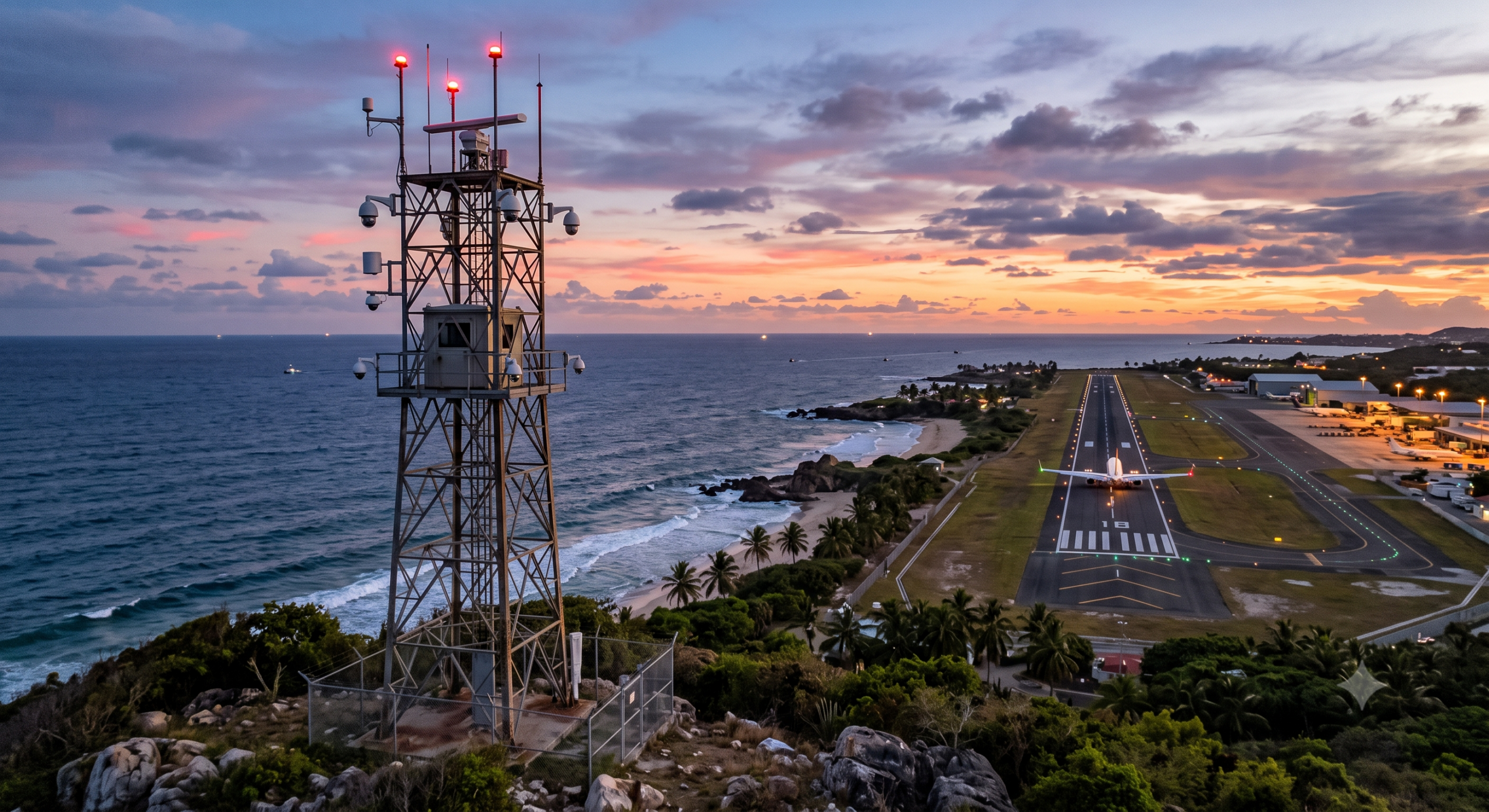
The Aguadilla Airport case stands apart from most entries on this site in one important way: it’s one of the few publicly available UAP videos that shows apparent trans-medium movement — an object appearing to travel from air to water — captured not by military sensors but by U.S. Customs and Border Protection surveillance infrastructure.
What Was Recorded
The footage dates to 2013 and was captured by an infrared camera system operated by U.S. Customs and Border Protection near Rafael Hernández Airport in Aguadilla, Puerto Rico — part of the government’s routine coastal surveillance infrastructure, not a dedicated UAP-monitoring system. The footage shows a bright object moving over the airport area and, in the portion that has drawn the most attention, appearing to descend toward and disappear into the ocean without the splash or deceleration pattern that would typically accompany a conventional aircraft or object entering water.
Why the “Trans-Medium” Framing Matters
“Trans-medium” — moving between distinctly different physical environments, like air and water, without an observable transition consistent with known technology — is one of the more specific and technically significant claims in UAP research, because it’s genuinely hard to explain with conventional aircraft, which are not built to survive high-speed water entry, or with typical drones or balloons, which don’t submerge. That’s precisely why this case is treated as notable rather than routine, and why DHS confirmation of the video’s authenticity is a meaningfully different situation than the same footage circulating without any official confirmation at all.
What DHS Actually Confirmed
The Department of Homeland Security has confirmed the footage is authentic CBP-captured video from its Aguadilla surveillance system. As with the Navy videos covered elsewhere on this site, it’s important to be precise about the boundary of that confirmation: DHS verifying the footage is real, unaltered surveillance video is a different claim than DHS confirming what the object actually was or that it genuinely entered the water rather than, for instance, descending behind the sightline created by the camera’s viewing angle relative to the horizon — a known source of visual ambiguity in this kind of footage that independent analysts have raised as a real, unresolved question about this specific case.
Current Status
This case remains among the unresolved records in the official UAP catalog. The core open questions are whether the object genuinely entered the water (versus a camera-angle effect) and, if it did, what it actually was — neither of which has a confirmed official answer as of the most recent public case reporting.
Primary Sources
DHS’s confirmation of footage authenticity and the National Archives’ RG 615 collection (covered in our Reader’s Guide) are the places to check for the current official record on this case, rather than re-uploaded copies with added commentary.
Frequently Asked Questions
Has the object been confirmed to have actually entered the ocean?
Not with full certainty — the camera’s viewing angle relative to the horizon is a genuine source of ambiguity that independent analysts have raised, and no official source has definitively resolved whether the object descended below the horizon line as viewed by the camera versus actually entering the water.
Why was this captured by CBP instead of the military?
Aguadilla is near a former Air National Guard base and the surrounding coastline falls under routine CBP surveillance coverage as part of standard border and coastal monitoring infrastructure — the object was captured incidentally by that existing system, not by a purpose-built UAP sensor.
Are there other trans-medium UAP cases in the official record?
Genuinely confirmed trans-medium cases are rare in the publicly released record, which is part of why the Aguadilla footage draws sustained attention — most released UAP footage shows aerial-only observation without an apparent environment transition.