
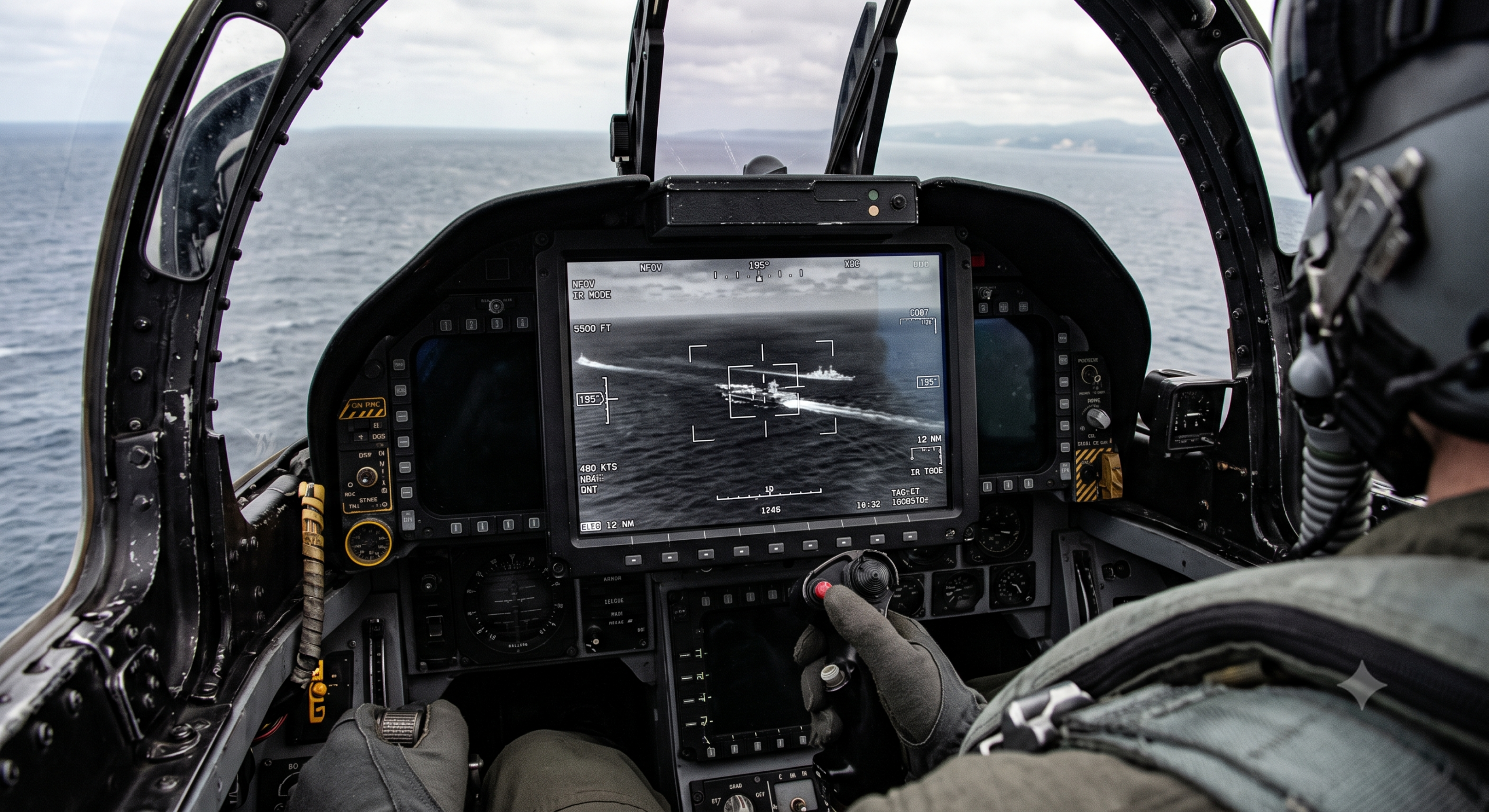
In April 2020, the Department of Defense officially released three infrared videos captured by Navy pilots, formally acknowledging what had already leaked years earlier: the footage was real, and the objects in it remained unexplained. The most famous of the three is “FLIR1,” better known by its nickname — the Tic Tac.
What Actually Happened in 2004
The incident took place off the coast of San Diego during a training exercise involving the USS Nimitz carrier strike group. For roughly two weeks prior, Navy radar operators aboard the USS Princeton had been tracking unusual objects descending from high altitude to hover near the ocean surface, then vanishing from radar — a pattern that didn’t match any known aircraft. On November 14, 2004, two F/A-18F Super Hornet pilots, including Commander David Fravor, were directed to investigate one of these radar contacts.
Fravor and his wingman visually observed an oblong white object — roughly the size and shape of a Tic Tac breath mint, hence the nickname — moving erratically over the water below them, with no visible wings, exhaust plume, or rotors. As Fravor descended toward it, the object mirrored his movement and then accelerated away at a speed and rate of climb that, according to his account and subsequent Navy statements, did not match any known aircraft capability of the era. A second aircraft in the group, equipped with an infrared FLIR (forward-looking infrared) targeting pod, captured the footage that would later become public: the object visible as a bright thermal signature against the ocean, moving in ways the pilot narrating the footage describes as inconsistent with a conventional aircraft.
What Corroborates the Pilot Accounts
This case is taken more seriously than a typical eyewitness UFO report for a specific reason: it isn’t just pilot testimony. The USS Princeton’s advanced radar system had been tracking the same class of object for roughly two weeks before the intercept, logging altitude changes and flight behavior independently of the pilots. Multiple aircrew members across separate sorties reported visually consistent observations. That combination — radar data, FLIR video, and multiple independent witness accounts across different platforms — is what elevates this from an anecdote to a documented incident worth DoD’s own formal investigation.
What the DoD Actually Confirmed (and Didn’t)
When the Pentagon officially released the FLIR1 video in April 2020, the confirmation was narrower than headlines often suggested. The Department of Defense confirmed that the video is authentic Navy footage and that the objects captured in it — across all three released videos — remain officially classified as unidentified. That is the full extent of the official confirmation: the footage is real, and no conventional explanation has been confirmed. The DoD did not confirm the objects are extraterrestrial, experimental aircraft, or anything else specific — and no legitimate official source has.
Current Status: Still “Unresolved”
As of AARO’s (the All-domain Anomaly Resolution Office) most recent public case classifications, the Tic Tac incident remains listed as unresolved. It’s worth being precise about what that classification actually means, since it’s commonly misunderstood: “unresolved” is not a synonym for “extraordinary” or “confirmed anomalous.” It means investigators lack sufficient reliable data — precise distance measurements, the original raw sensor files rather than a compressed public release, independent multi-sensor corroboration meeting a technical evidentiary bar — to confidently support either a conventional or an extraordinary explanation. The Tic Tac case has more corroborating evidence than most UAP reports (which is part of why it remains so widely discussed), but “more evidence than average” is not the same as “confirmed anomalous craft.”
Primary Sources
The original FLIR1 footage and the DoD’s official April 2020 release statement are the primary record for this case, alongside AARO’s public case-status reporting. As covered in our Reader’s Guide to the National Archives’ RG 615 UAP Collection, related records are being added to the National Archives’ official collection on a rolling basis — that’s the authoritative place to check for updates, not secondary commentary or re-uploaded copies of uncertain provenance.
Frequently Asked Questions
Was the Tic Tac object confirmed to defy the laws of physics?
No official source has made this claim. Pilot accounts describe apparent acceleration and maneuvering that they, as experienced aviators, could not attribute to any known aircraft they were familiar with — but “outside a pilot’s frame of reference” and “physically impossible” are different claims, and only the former has been formally documented.
Is the full, unedited FLIR footage available publicly?
The publicly released video is a relatively short compressed clip; the existence and status of longer or higher-resolution original sensor files has been a recurring point of interest for researchers and is part of why AARO’s “insufficient data” and “unresolved” classifications exist as distinct categories from a full technical explanation.
How does the Tic Tac case relate to the Gimbal and GoFast videos?
All three were released by the DoD in the same April 2020 announcement but are separate incidents from different years and locations. See our explainers on the Gimbal video and the GoFast video for those cases specifically.